Before your MOT: the checks you can do yourself
Before your car's MOT: the most common reasons cars fail, which of them you can check yourself, and when and how to book the test.
Before your car's MOT: the most common reasons cars fail, which of them you can check yourself, and when and how to book the test.
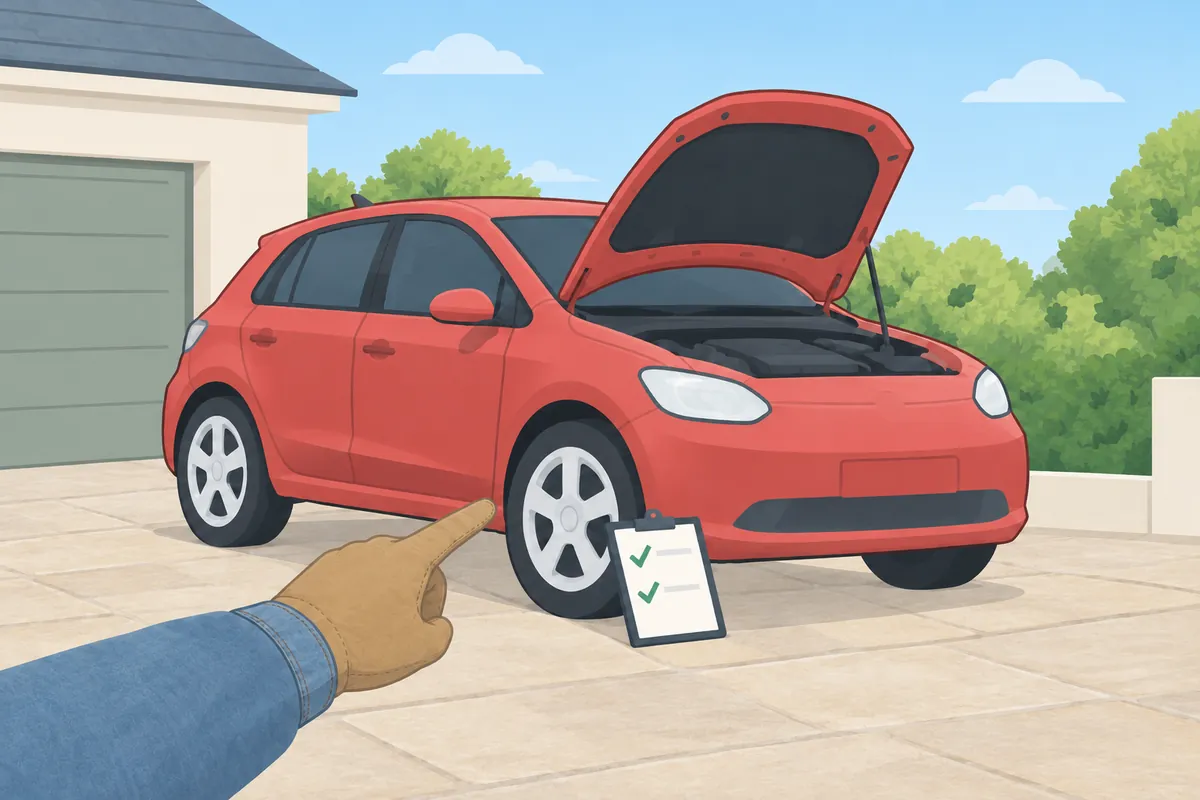
From April 2025 to March 2026, over a quarter of MOT tests on cars and light vans (27.51%) were failed, as the vehicles were brought in for the test.1
| Area (DVSA's name) | Tests that failed on it | Your check |
|---|---|---|
| Lamps, reflectors and electrical equipment | 10.44%1 | Check 1 |
| Suspension | 8.90%1 | Check 2 |
| Tyres | 6.23%1 | Check 3 |
| Brakes | 6.10%1 | Check 4 |
| Visibility | 4.28%1 | Check 5 |
One test can fail in several areas, so the figures overlap.1
Each of the five most common reasons for failing has a check you can do yourself before the test. If one shows a problem, such as worn shock absorbers, get it fixed before the test.
This advice is from GOV.UK and the Highway Code, which GOV.UK shows as last updated on 22 October 2025.2
Your lights
Your suspension
Your tyres
From April 2025 to March 2026, 60.60% of the dangerous defects found at MOTs were in tyres.1
Your brakes
Your view of the road
From your handbook
The MOT doesn't cover the condition of the engine, clutch or gearbox.4 A car can be unsafe even if it has a current MOT certificate.3
When
You must get an MOT by the third anniversary of your car's registration, and after that by the anniversary of its last MOT.5 Some vehicles need to be tested at one year old: GOV.UK's MOT fees table says which.5
An MOT lasts for a year. The date it runs out is in your MOT history, or printed on your current MOT certificate if you have one.5
Roadworthy checks tax, MOT and MOT history from scanning or entering a number plate.
Free, for Android.
You can get an MOT up to a month (minus a day) before it runs out and keep the same renewal date: if it runs out on 15 May, the earliest is 16 April.5
If you get it earlier, next year's renewal date changes to one year (minus a day) from the date it passed.5
You can sign up to get reminders that your MOT is due.5
You must use an approved MOT test centre: only centres showing the blue sign with 3 white triangles can carry out your MOT. Contact one to book.6
Some MOT centres will collect your car for the MOT and then return it: ask the centre if it offers this.6
The most an MOT centre can charge for a car's MOT is £54.85.7
If it has run out
You can't drive or park your car on the road if its MOT has run out, except to drive it to or from somewhere to be repaired, or to a pre-arranged MOT test.5
You can be fined up to £1,000 for driving a vehicle without a valid MOT.5
If it fails, see My car failed its MOT: what now?
This guide covers England, Scotland and Wales. Northern Ireland has different rules and processes for MOTs for vehicles registered there.5
DVSA's figures cover cars and light vans up to 3,000kg in Great Britain, and DVSA says they are not classed as an official statistic.1
First published 14 October 2026. Last updated 14 October 2026. General information, not legal advice.